Stainless Steel Braided Solar Cable: Is It Really Rodent Resistant?
Sep 22, 2026
Rodent damage is a recognized concern for exposed photovoltaic wiring, particularly in ground-mounted solar farms, agricultural PV systems, rooftop installations, and other outdoor environments. One cable construction used to address this problem is stainless steel braided solar cable, which places a metal braid around the insulated PV cable.
But does a stainless steel braid actually make a solar cable rodent resistant? The answer depends on the cable construction, the protection method, and the installation environment. A stainless steel braid provides a physical barrier against biting and mechanical contact, but it should not be treated as a guarantee that a cable can never be damaged.
How Does Stainless Steel Braided Solar Cable Protect Against Rodents?
The key difference is the stainless steel braided layer surrounding the cable.
A conventional PV cable generally consists of a conductor, insulation, and outer jacket. A stainless steel braided design adds another protective layer outside the insulated cable.
A typical construction is:
Tinned Copper Conductor → XLPO Insulation → Stainless Steel Braid → XLPO Outer Jacket
The metal braid makes it more difficult for rodents to directly reach the polymer layers underneath. It also adds mechanical protection against abrasion and external contact. Hongzhou's stainless steel braided solar cable uses tinned copper, XLPO insulation and jacket, a stainless steel protective layer, and H1Z2Z2-K construction with up to 1500V DC rating.
Is Stainless Steel Braid Really Rodent Resistant?
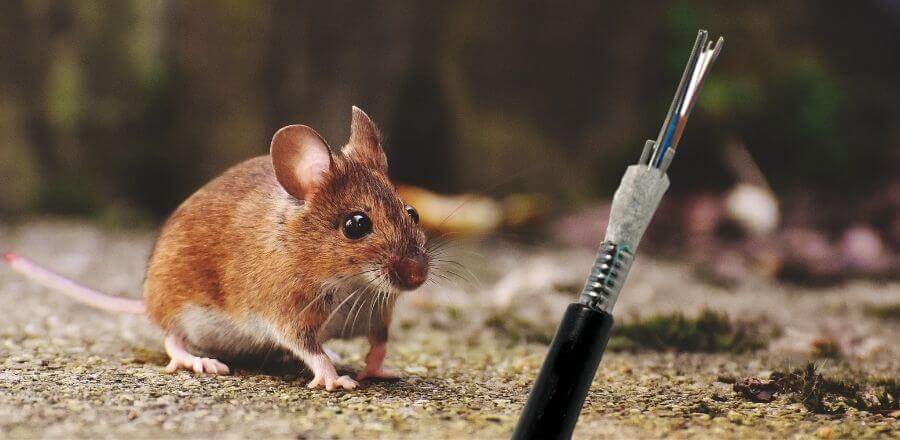
Yes, as a physical protection method, stainless steel braid can provide rodent resistance.
Industry sources specifically identify braided stainless-steel mesh as a rodent-protection option for solar cables. A technical article in North American Clean Energy describes specialized solar cables using braided stainless-steel mesh around the cable to protect against rodents. FlipHTML5
Other manufacturers also market stainless steel braided PV cable specifically for anti-rodent applications, showing that this construction is an established approach rather than a marketing term created for one product. LinkedIn
The important distinction is that the braid works by creating a physical barrier. It does not depend on an animal deterrent additive or a chemical treatment.
Why Use Stainless Steel Instead of Only a Reinforced Jacket?
There are several ways to increase rodent resistance in a cable.
A reinforced polymer jacket can make the outer surface more difficult to penetrate. Rodent-deterrent materials can also be incorporated into some cable designs. Another approach is physical protection using metal.
Stainless steel braid belongs to the third category.
Its advantage is that the protection is a separate physical layer around the insulated cable. This also gives the cable additional resistance to abrasion and external mechanical contact. Hongzhou describes its braided cable as adding mechanical protection while maintaining flexibility for PV installation.
For projects where both rodent protection and mechanical protection matter, this construction can therefore serve more than one purpose.
Stainless Steel Braid Does Not Mean "Indestructible"
This is an important point when evaluating any rodent-resistant solar cable.
"Rodent resistant" should not be interpreted as "impossible for any animal to damage." The actual protection depends on the braid construction, cable design, installation conditions, and the type and severity of external force.
The stainless steel layer is intended to make direct biting damage significantly more difficult and protect the cable underneath. Proper cable routing and support are still important.
For example, a cable installed against sharp metal edges can experience mechanical damage even when it has a protective braid. Likewise, exposed connections and improperly supported cable sections may require additional protection.
The best approach is therefore to treat rodent-resistant cable as one layer of PV cable protection, not a replacement for correct installation.
What Is the Difference Between Anti-Rodent PV Cable and Stainless Steel Braided Solar Cable?
The terms are related, but they describe slightly different things.
Anti-rodent PV cable describes the intended protection function.
Stainless steel braided solar cable describes the physical construction used to provide additional protection.
Hongzhou's Anti Rodent PV Cable uses stainless steel braided protection as part of its construction.
The same principle appears in the company's Anti Rodent Solar PV Cable, which is designed for photovoltaic installations requiring additional protection against animal damage.
In other words, stainless steel braided construction can be the technical basis for an anti-rodent solar cable rather than being a completely separate product category.
Where Is Stainless Steel Braided Solar Cable Used?
The construction is particularly relevant where PV cables are exposed to outdoor conditions.
Large solar farms can contain extensive DC cable routes across open outdoor areas. Where rodent activity is a known concern, adding physical protection directly to the cable can reduce exposure to bite damage.
Agricultural solar projects place electrical equipment and cable routes close to farmland, vegetation, and animal activity. This makes rodent-resistant cable construction relevant to selected cable sections.
Rodents and squirrels can access wiring beneath solar modules. Community discussions from solar owners and installers frequently mention damaged PV wiring and the use of animal barriers or additional cable protection. A stainless steel braided cable provides protection directly around the cable itself.
Remote solar installations may be more difficult to inspect and repair. A cable with additional mechanical protection can be useful where exposed wiring is difficult to access regularly.
Hongzhou lists solar farms, rooftop PV, agricultural solar installations, and other outdoor photovoltaic applications for its anti-rodent cable products.
Does the Stainless Steel Braid Affect Cable Flexibility?
This is one of the practical reasons to use a braided structure rather than simply relying on a rigid protective enclosure.
The stainless steel braid adds protection around the cable while allowing the cable to retain a flexible construction. Hongzhou specifically describes its stainless steel braided solar cable as combining mechanical protection with flexibility for solar installation.
This matters when cables need to be routed around PV modules, mounting structures, junction boxes, or other equipment.
The final bending requirements should still be checked against the actual cable specification and installation method.
What Electrical Specifications Still Matter?
Rodent resistance does not replace normal PV cable requirements.
A rodent-resistant PV cable still needs to match the system voltage, conductor size, insulation system, temperature range, and applicable standards.
Hongzhou's anti-rodent cable is listed with:
| Specification | Details |
|---|---|
| Cable Type | H1Z2Z2-K Solar PV Cable |
| Conductor | Tinned Copper |
| Conductor Size | 1.5–400 mm² |
| Insulation | XLPO |
| Protective Layer | Stainless Steel Braided Shield |
| Rated Voltage | DC 1500V |
| Test Voltage | 6500V AC |
| Temperature | -40°C to +105°C |
IEC 62930 is a relevant standard for single-core cross-linked insulated and sheathed cables used on the DC side of photovoltaic systems up to 1.5 kV DC. The H1Z2Z2-K designation is also widely used for PV cable constructions.
Can Stainless Steel Braided Cable Replace Conduit?
Not necessarily.
A braided PV cable and an external conduit solve protection in different ways. Stainless steel braid makes the cable itself more resistant to mechanical and rodent damage, while conduit provides an additional enclosure around the cable.
The appropriate choice depends on the cable route, installation requirements, mechanical exposure, and project specifications.
For projects that need a ready-to-connect cable assembly, Hongzhou also offers MC4 Solar Connector Cable with pre-installed connectors and customizable cable length.
What About Anti-Rat and Anti-Mouse Solar Cable?
You may see several different search terms used for similar products:
Anti-rodent solar cable
Rodent-resistant PV cable
Anti-rat solar cable
Rat-proof solar cable
Anti-mouse solar cable
Stainless steel braided solar cable
Stainless steel shielded solar cable
These terms do not necessarily indicate identical constructions. The actual cable structure should be checked before comparing products.
For example, Hongzhou's Rat-proof Cable is positioned specifically around rodent protection.
Its Anti-rodent Cable is specified with a stainless steel shield braid, tinned copper conductor, XLPO insulation and jacket, and DC 1500V rating.
So, Is Stainless Steel Braided Solar Cable Worth Using?
For PV projects where rodents and mechanical exposure are genuine cable risks, stainless steel braided construction provides a direct form of physical protection.
Its value comes from the combination of:
- Stainless steel physical barrier
- Additional mechanical protection
- Flexible cable construction
- PV-rated electrical design
- Suitability for exposed outdoor applications
It does not eliminate the need for proper cable routing or installation. What it does is move part of the protection directly into the cable structure, which can be particularly useful where exposed PV wiring is difficult to protect with separate components.