


How To Stop Mice From Chewing Electrical Cables (Proven Solutions)
Sep 10, 2026
Rodent damage to electrical cables can create serious problems for solar farms, industrial facilities, warehouses, agricultural projects, and other outdoor electrical systems. Once mice or rats damage the cable jacket, the result can include insulation failure, short circuits, power interruptions, safety risks, and repeated maintenance costs.
The practical way to reduce this risk is not simply to remove rodents after damage occurs. The cable itself should be selected and installed with protection against mechanical damage and rodent activity.
This guide explains why mice chew electrical cables, which cable structures provide better protection, and how project buyers can build a more reliable rodent-resistant cable solution.

Why Do Mice Chew Electrical Cables?
Mice and rats naturally gnaw on objects because their teeth continue growing. Electrical cables can become easy targets when the outer insulation is relatively soft or when cables are installed in warm, hidden, or outdoor areas.
Common risk factors include:
- Soft or easily penetrated cable jackets
- Warm spaces around equipment
- Hidden cable routes that are difficult to inspect
- Outdoor installations exposed to vegetation and soil
- Large cable networks with many inaccessible sections
For solar farms, warehouses, factories, agricultural facilities, and utility projects, one damaged cable can affect more than a single connection.
The real concern for project owners is the chain reaction:
Rodent chewing → damaged jacket → exposed insulation/conductor → electrical fault → equipment shutdown → repair and maintenance costs
For large installations, preventing the first step is usually more practical than repeatedly repairing damaged cables.
Best Ways to Stop Mice from Chewing Electrical Cables
👉If you need a quick answer, an effective rodent protection strategy normally combines cable construction, physical protection, installation design, and site management.
✅1. Use Rodent-Resistant Cables
A reinforced outer structure makes it more difficult for mice and rats to penetrate the cable.
Common options include:
- Stainless steel braided protection
- Metallic armor
- Reinforced outer jackets
- High-strength insulation materials
- Multi-layer cable structures
For outdoor photovoltaic projects, a rodent-resistant solar cable can provide protection directly at the cable level without relying entirely on external conduits.
✅2. Add Physical Cable Protection
Depending on the installation environment, buyers can also use:
- Cable conduits
- Cable trays
- Protective sleeves
- Sealed cable routes
- Proper cable fastening
This is especially useful around equipment entrances, underground sections, and areas with known rodent activity.
✅3. Improve Cable Routing
Avoid leaving cables unnecessarily exposed.
Where project conditions allow:
- Keep cables away from ground contact
- Avoid loose cable loops
- Protect cable entry points
- Separate cables from areas with visible rodent activity
Keep cable routes accessible for inspection
Cable protection works better when combined with basic site management.
For factories, warehouses, and agricultural facilities, reduce accessible food sources, standing waste, vegetation around critical cable routes, and unnecessary openings into electrical areas.
Why Rodent Protection Matters in Solar Power Systems
Solar PV installations are particularly exposed to rodent damage because cables are distributed across large areas and are often installed outdoors.
Typical conditions include:
- Long DC cable routes
- Outdoor cable exposure
- Vegetation and soil around installations
- Junction boxes and inverter connections
- Large numbers of PV strings
- Difficult-to-access cable sections
A damaged cable can cause:
- Power loss
- Insulation damage
- Ground faults
- Unexpected maintenance
- System downtime
- Higher project operating costs
For solar cable manufacturers, PV distributors, EPC contractors, and solar project suppliers, rodent protection should therefore be considered during cable specification rather than after a failure occurs.
A rodent-resistant solar cable is particularly suitable when cables are exposed to open fields, farmland, mountains, remote PV sites, and other areas where rodent activity is difficult to control.
A rodent-resistant cable does not depend on one feature alone. The protection comes from the cable structure and the materials used for the insulation, shielding, and outer jacket.
A practical design may include:
- Reinforced insulation to make penetration more difficult
- Metallic protection to create a physical barrier
- Durable outer jacketing for outdoor exposure
- UV and weather-resistant materials for long-term PV installation
- Flexible stranded conductors for easier routing and installation
The right combination depends on the project environment, voltage requirement, installation method, cable size, and expected mechanical exposure.
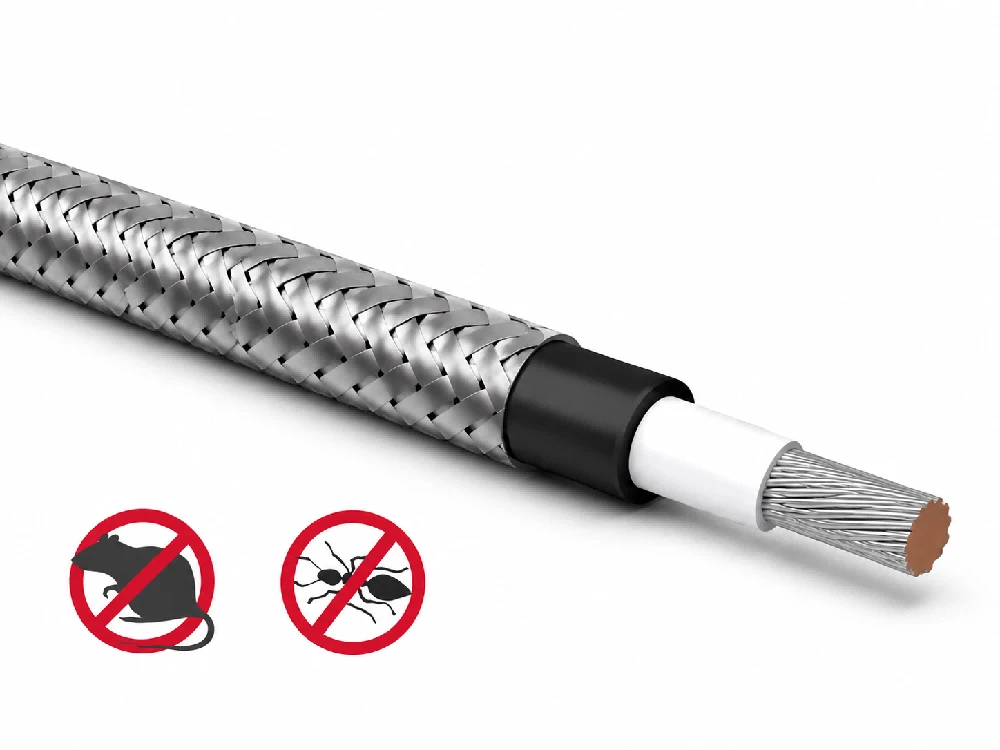
Stainless Steel Braided Protection for Solar Cables
For photovoltaic applications, stainless steel braided protection provides a useful balance between mechanical protection and cable flexibility.
A typical structure can include:
Tinned Copper Conductor → XLPO Insulation → Stainless Steel Braided Shield → XLPO Outer Jacket
The stainless steel braid forms an additional protective layer outside the cable jacket. It helps reduce the risk of damage caused by rodent bites and other external mechanical contact while maintaining flexibility for installation.
For buyers sourcing from a China anti-rodent solar cable manufacturer, this type of construction can be specified according to cable size, voltage rating, jacket requirements, connector configuration, and project installation conditions.
What Makes a Reliable Anti-Rodent Solar Cable?
For a commercial PV project, rodent resistance should not be evaluated separately from the cable's electrical and environmental performance.
A suitable cable should also consider:
✅Mechanical Protection
A stainless steel braided layer adds a physical barrier between the outer environment and the cable insulation.
✅UV and Weather Resistance
Solar cables installed outdoors need insulation and jacket materials suitable for long-term exposure to sunlight and changing weather conditions.
✅Electrical Performance
The cable still needs to meet the project's voltage, conductor size, insulation, and testing requirements.
✅Flexibility
A heavily protected cable should still be practical for routing around solar panels, junction boxes, inverters, and other equipment.
✅Project Customization
For bulk orders, buyers may require customized cable sizes, lengths, colors, conductor specifications, connectors, labels, and packaging.
Rodent-Resistant Solar Cable Specifications
For example, an anti-rodent solar cable can be designed with the following specifications:
| Item | Specification |
|---|---|
| Conductor | Tinned Copper |
| Conductor Size | 1.5–400 mm² |
| Insulation | XLPO |
| Rodent Protection | Stainless Steel Braided Shield |
| Outer Jacket | XLPO |
| Rated Voltage | DC 1500V |
| Test Voltage | 6500V AC |
| Temperature Range | -40°C to +105°C |
| Cable Type | H1Z2Z2-K |
| Conductor Type | Flexible Stranded Copper |
| Customization | Size, conductor, braid, jacket color, packaging |
👉The actual cable specification should be selected according to the electrical design and installation requirements of the project rather than using one specification for every application.
Where Are Rodent-Resistant Electrical Cables Most Needed?
Rodent-resistant cable solutions are useful wherever cable damage can create expensive downtime, difficult maintenance, or safety concerns.
✅Solar Farms and PV Projects
Large solar installations have extensive outdoor DC cable networks. Rodent-resistant PV cables can help protect exposed cable routes and reduce the likelihood of damage in open-field environments.
✅Agricultural Solar Systems
Farmland and agricultural areas can have higher rodent activity. This makes anti-rodent solar cables for agricultural PV projects a practical option for exposed installations.
✅Factories and Industrial Facilities
Industrial plants often contain complex electrical systems, equipment connections, cable trays, and hidden cable routes.
Cable damage can lead to:
- Equipment shutdown
- Production interruptions
- Electrical troubleshooting
- Unplanned maintenance
- Replacement costs
✅Warehouses and Processing Facilities
Warehouses provide many hidden spaces where rodents can remain undetected. Cables installed near walls, ceilings, storage areas, and equipment can be difficult to inspect regularly.
✅Outdoor Infrastructure
Utility systems, communication infrastructure, remote electrical equipment, and other outdoor installations may also benefit from additional cable protection where rodent activity is a known risk.
Rodent Protection Should Be Part of the Cable Specification
Choosing a thicker cable jacket after a rodent problem occurs is not always the most practical approach.
For project buyers, the better process is:
Identify the rodent risk → Check the installation environment → Select cable structure → Confirm electrical requirements → Add physical protection where necessary → Define testing and customization requirements
This approach allows EPC contractors, solar distributors, electrical wholesalers, system integrators, and project suppliers to specify the cable before installation rather than treating rodent damage as a later maintenance problem.
A professional rodent-resistant cable supplier should also be able to discuss conductor size, insulation material, protective structure, voltage rating, temperature range, cable length, connector assembly, and other project requirements.
How to Choose a Rodent-Resistant Cable Supplier?
Before placing a bulk order, buyers should check more than the phrase "rodent-proof cable."
Consider these points:
✅1. Cable structure
Ask what physical layer provides rodent protection and whether it is suitable for the intended installation.
✅2. Electrical specifications
Confirm conductor material, cross-sectional area, voltage rating, insulation, temperature range, and applicable cable standard.
✅3. Outdoor performance
For PV applications, check UV, weather, and temperature resistance.
✅4. Testing and quality control
Confirm whether the manufacturer performs electrical and final product inspections before shipment.
✅5. Customization capability
For OEM projects, confirm whether the supplier can customize cable size, length, jacket color, conductor specification, connectors, labels, and packaging.
FAQ
1.What is the best cable to prevent mice from chewing?
For high-risk installations, cables with a reinforced or metallic protective layer generally provide stronger physical resistance than standard PVC-jacketed cables. The appropriate structure depends on the installation environment.
2.Do rodent-resistant cables completely stop mice from chewing?
No cable should be treated as an absolute guarantee against rodent activity. Rodent-resistant designs increase resistance to chewing and mechanical penetration, while proper routing and site management provide additional protection.
3.Are rodent-resistant cables suitable for solar farms?
Yes. They are particularly useful for outdoor PV installations where cables are exposed to soil, vegetation, rodents, and large-area cable routing.
4.What is an anti-rodent solar cable?
An anti-rodent solar cable is a photovoltaic cable designed with additional protection against rodent damage. Depending on the design, this may include metallic braiding, armor, reinforced insulation, or other protective structures.
5.Can anti-rodent solar cables be customized?
Yes. For OEM and bulk projects, customization can include conductor size, cable length, protective layer, jacket color, cable specifications, connectors, labeling, and packaging.


