


How To Protect Solar Cables From Rodents? Try Stainless Steel Braided Solar Cable
Sep 11, 2026
Solar cables are exposed to much more than sunlight and weather. In ground-mounted solar farms, agricultural PV projects, rooftop installations, and remote photovoltaic systems, rodents can also become a serious source of cable damage.
Mice and rats may chew through the outer jacket of a conventional PV cable, exposing the insulation and creating potential electrical faults. For EPC contractors, solar installers, distributors, and project owners, replacing damaged cables after installation can mean additional labor, downtime, and maintenance costs.
So, how can solar cables be protected from rodents? One practical approach is to use a stainless steel braided solar cable that adds a physical protection layer around the conventional PV cable structure.

Why Do Rodents Damage Solar Cables?
Rodents naturally gnaw on materials, and solar cable routes can provide convenient targets, especially in outdoor environments.
Several conditions can increase the risk:
- Open-field solar installations
- Agricultural land with high rodent activity
- Remote PV projects with limited inspection
- Cables installed close to the ground
- Vegetation around cable routes
- Large cable networks that are difficult to monitor
Once a rodent damages the outer jacket, the cable can become vulnerable to further environmental exposure and mechanical damage.
The problem is not limited to the cable itself:
Rodent bite → damaged jacket → exposed insulation → electrical fault → system maintenance → additional project cost
For large photovoltaic installations, preventing cable damage at the specification stage can be more practical than relying on repairs after failure.
What Happens When Rodents Chew Solar Cables?
Rodent damage can start with a small bite mark but develop into a larger electrical and maintenance problem.
1.Damaged Cable Insulation
When the outer jacket and insulation are penetrated, the conductor becomes less protected from the surrounding environment.
2.Electrical Fault Risk
Damaged insulation can increase the possibility of electrical faults and affect the reliability of the PV circuit.
3.Unexpected Maintenance
Technicians may need to locate damaged sections, replace cables, and inspect nearby connections.
4.Higher Operating Costs
For large solar farms, repeated cable replacement can involve material, labor, transportation, and system downtime costs.
This is why rodent-resistant solar cable is worth considering for PV projects where animal activity is a known risk.
How to Protect Solar Cables from Rodents?
There are several ways to improve solar cable protection.
1.Use Protective Conduits or Covers
Cable conduits, pipes, and protective covers can create a physical barrier between rodents and the cable.
This method can work well in certain installation environments, but it also adds additional components and installation work.
2.Improve Cable Routing
Keeping cables properly secured and away from areas with obvious rodent activity can reduce exposure.
For ground-mounted PV systems, cable routing should be considered together with vegetation management, equipment positioning, and inspection access.
3.Choose a Rodent-Resistant Cable
Instead of adding protection around the cable after production, another option is to build mechanical protection directly into the cable structure.
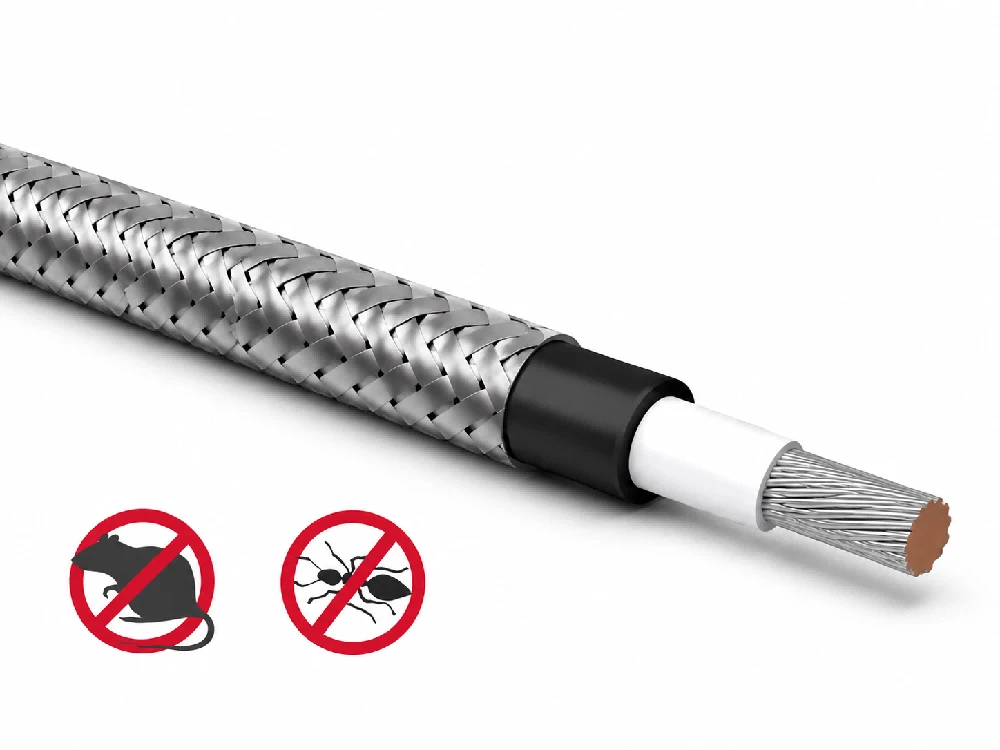
A stainless steel braided solar cable uses a stainless steel braided layer around the cable to create an additional physical barrier against rodent bites and external mechanical damage.
Why Choose Stainless Steel Braided Solar Cable?
The main difference between a conventional PV cable and a stainless steel braided solar cable is the additional protective layer.
A typical structure can be arranged as:
Tinned Copper Conductor → XLPO Insulation → Stainless Steel Braided Layer → XLPO Outer Jacket
Each layer has a different function.
1.Tinned Copper Conductor
Provides electrical conductivity while maintaining the flexibility needed for solar cable installation.
2.XLPO Insulation
Provides electrical insulation and helps the cable withstand outdoor operating conditions.
3.Stainless Steel Braided Layer
Creates an additional mechanical barrier around the cable. It helps reduce the risk of damage caused by rodent bites, abrasion, and external contact.
4.XLPO Outer Jacket
Provides protection against sunlight, moisture, temperature changes, and general outdoor exposure.
This multi-layer construction makes stainless steel braided PV cable suitable for projects where standard cable protection is not sufficient.
Stainless Steel Braid Adds Protection Without Making the Cable Difficult to Install
A protection layer is only useful if the cable remains practical for field installation.
For photovoltaic applications, cable routes can pass around:
- Solar modules
- Junction boxes
- Inverters
- Cable trays
- Mounting structures
- Outdoor electrical equipment
The stainless steel braided structure provides additional mechanical protection while retaining flexibility for cable routing.
For solar cable buyers, this creates a useful balance between rodent protection, outdoor durability, and installation practicality.
What Specifications Should Buyers Check?
Choosing a rodent-resistant solar cable should not be based only on the word "rodent-resistant."
Project buyers should also evaluate the electrical and environmental specifications.
| Item | Typical Specification |
|---|---|
| Conductor | Tinned Copper |
| Conductor Size | 1.5–400 mm² |
| Insulation | XLPO |
| Protection Layer | Stainless Steel Braided Shield |
| Outer Jacket | XLPO |
| Rated Voltage | DC 1500V |
| Test Voltage | 6500V AC |
| Temperature Range | -40°C to +105°C |
| Cable Type | H1Z2Z2-K |
| Conductor Structure | Flexible Stranded Copper |
| Customization | Cable Size, Color, Specifications |
These specifications are suitable as a reference for project evaluation. The final cable configuration should be selected according to the PV system design, installation environment, and applicable requirements.
Where Is Stainless Steel Braided Solar Cable Most Useful?
Not every PV project has the same level of rodent risk. Additional cable protection becomes more valuable in certain environments.
1.Ground-Mounted Solar Farms
Large solar farms cover extensive outdoor areas, making cable inspection and rodent control more difficult.
A rodent-resistant PV cable can provide additional protection along exposed cable routes.
2.Agricultural Solar Projects
Agricultural PV installations are surrounded by soil, vegetation, and animal activity. These conditions can increase the possibility of rodent-related cable damage.
3.Remote Solar Projects
Remote installations may have limited access for regular inspection and maintenance. Reducing the likelihood of cable damage can help reduce future service requirements.
4.Rooftop Solar Systems
Rooftop installations may also encounter rodents around cable routes, equipment rooms, and building structures. Additional mechanical protection can be useful where standard PV cable protection is considered insufficient.
Rodent Protection Is Only One Part of Solar Cable Selection
For professional solar cable buyers, rodent resistance should not replace the basic requirements for photovoltaic cable performance.
A suitable cable should also be evaluated for:
- Voltage rating
- Conductor size
- Insulation and jacket material
- UV resistance
- Weather resistance
- Temperature range
- Mechanical protection
- Flexibility
- Connector compatibility
- Required certifications
For example, Hongzhou's stainless steel braided anti-rodent solar cable uses tinned copper conductors, XLPO insulation and jacket, stainless steel braided protection, and a DC 1500V rating, with customized cable specifications available for different project requirements.
Should You Choose a Rodent-Resistant Solar Cable or External Protection?
The right choice depends on the project.
| Protection Method | Suitable When | Main Consideration |
|---|---|---|
| Standard PV Cable | Low rodent-risk environments | Basic cable protection |
| Protective Conduit | Specific exposed cable routes | Adds installation components |
| Cable Cover | Localized high-risk areas | Requires additional installation |
| Stainless Steel Braided Solar Cable | High rodent-risk outdoor projects | Protection is built into cable structure |
| Combined Protection | High-risk or difficult environments | Higher overall protection |
For large-scale projects, a stainless steel braided solar cable manufacturer can also customize the cable structure according to conductor size, cable length, protection requirements, jacket color, and packaging.
How Should Solar Project Buyers Specify Rodent Protection?
For EPC contractors, solar installers, wholesalers, and photovoltaic distributors, the requirement can be defined during the cable procurement stage.
A practical specification process is:
1. Identify the installation environment
Check whether the project is located in farmland, open fields, mountains, remote areas, or other environments with higher rodent activity.
2. Determine the electrical requirements
Confirm voltage, conductor size, cable type, and applicable standards.
3. Select the protection structure
Decide whether standard PV cable, external protection, or stainless steel braided protection is appropriate.
4. Consider installation requirements
Check cable flexibility, routing, connector configuration, and cable length.
5. Confirm bulk manufacturing capability
For distributors and project suppliers, verify whether the solar cable supplier can maintain consistent specifications for repeated orders.
This approach turns rodent protection from a maintenance issue into part of the original cable procurement plan.
Stainless Steel Braided Solar Cable for Bulk Solar Projects
For a solar cable manufacturer, providing rodent-resistant protection is more than adding a metal layer to an existing product.
Bulk buyers may require:
- Customized conductor sizes
- Customized cable lengths
- Stainless steel braided protection
- Different jacket colors
- Pre-installed PV connectors
- Cable assemblies
- Customized packaging
- OEM production
Hongzhou provides anti-rodent solar cable solutions with stainless steel braided protection and supports customized cable specifications and OEM orders for solar installers, distributors, and photovoltaic project suppliers.
For projects that require ready-to-install products, pre-assembled cable lengths with PV connectors can also help reduce on-site cable preparation and connection work.


