


What Are The Different Types Of Solar Panel Connectors?
Feb 13, 2025
Contents
1. What are solar panel connectors?
2. Why are connectors important for solar panels?
3. What types of connectors are used for solar panels?
4. Differences between different solar connectors
5. Applications of solar connectors
6. How to connect solar connector wires
1. What are solar panel connectors?
Solar panel connectors are a device used to establish a safe and reliable electrical connection between solar panels. They also connect solar panels and other components of a photovoltaic system, such as inverters, charge controllers, and batteries. Solar panel connectors ensure efficient energy transfer and minimize any power loss in the system.

2. Why are connectors important for solar panels?
2.1. Safeguarding Efficiency
Connectors are critical to solar panel systems to ensure electrical efficiency, safety, weather resistance, scalability, ease of installation and maintenance, and compatibility between components. They minimize power losses and maintain overall system efficiency by providing a safe and reliable connection between solar panels and other components in the balance of system.
2.2. Safety Guarding
They prevent potential hazards, such as arcing or short circuits, and help withstand environmental conditions, such as UV radiation, extreme temperatures, and moisture. A high-quality connector should last the life of a solar PV system (approximately 25 to 30 years).
2.3. Flexible Configuration
Connectors help easily expand solar arrays and enable series or parallel configurations, allowing for flexible system design. They simplify installation, maintenance, and compatibility with different solar panel brands and components.
3. What type of connector is used for solar panels?
3.1. MC4
MC4 is the current industry standard for solar panel systems, providing a reliable and secure connection between solar panels and other components of a PV system. They are weatherproof, UV-resistant, and durable in harsh weather. They ensure a stable connection throughout the life of the solar array.
Features
Safety: Has male and female versions, ensuring proper connection and avoiding reverse polarity.
Durability: Able to last the life of a solar PV system (approximately 25 to 30 years).
Ease of Use: Has a simple push-in and lock mechanism, providing a secure connection and reducing the risk of accidental disconnection.
Compatibility: Compatible with a variety of solar panels, easy to install and maintain.

3.2.Y branch connector
The Y branch connector is a multi-way branch connector that can divide a main power line into multiple branches, each of which can be individually connected to different loads or devices.
Features
Multi-way branch design: The Y branch connector can divide a main power line into multiple branches, each of which can be individually connected to different loads or devices.
High current and high voltage carrying capacity: The Y branch connector needs to have sufficient voltage and current carrying capacity to cope with the high power output in the solar power generation system.
Pluggability: Generally has a pluggable design, which is convenient for installation and maintenance, allowing quick connection and disconnection, simplifying the installation and maintenance process of the system.

3.3.T4 connector
T4 connectors are another type of solar panel connector developed by Amphenol Industrial Solar Technologies. As an alternative to MC4, they have some improvements in safety and ease of use. T4 connectors have a threadless design that allows quick and easy installation and disconnection. They do not require specialized tools. Compared with MC4, T4 also has higher current carrying capacity and better durability.
Features
Quick Installation: Threadless design allows for quick and easy installation and disconnection.
High Current Carrying Capacity: Has higher current carrying capacity and better durability than MC4.
3.4.TYCO SolarLok
TYCO Solarlok connectors are specialized solar connectors manufactured by TE Connectivity (formerly Tyco Electronics). Solarlok connectors use a gender-neutral design that allows any two connectors to mate without the need for male and female components. They are compatible with a variety of wire sizes and have a locking mechanism for added security. These connectors are widely praised for their high-quality materials and durability. They also have excellent resistance to environmental factors such as UV radiation, extreme temperatures, and moisture.
Features
Weatherproof: Can withstand high temperatures, UV radiation, and other extreme conditions.
Security: Utilizes crimping technology to create a secure connection and is available in a variety of types, including male and female configurations.
3.5.Radox
The Radox connector, manufactured by HUBER+SUHNER, is another solar connector commonly used in the photovoltaic industry. Radox connectors use crimping technology to create a secure connection and are available in various types, including male and female configurations.
Features
Weather resistance: Can withstand high temperatures, UV radiation, and other extreme conditions.
Safety: Use crimping technology to create a secure connection and are available in various types, including male and female configurations.
4. Differences between different solar connectors
Comparing different connector types will give you a better understanding of their similarities and differences when building a solar power system. In the table below, we will look at various considerations.
4.1. Basic uses and essential type differences
MC4: It is an industry standard connector for solar panel systems. It is mainly used to establish a reliable and secure connection between solar panels and other components of the photovoltaic system. It is a basic connection component.
Y-branch connector: It is essentially a combination connector. Its function is to split a solar cable into two parallel connections. It is usually used with connectors such as MC4 to simplify the wiring of multiple panels. It is not a basic connection component.
T4 connector: a solar panel connector developed by Amphenol Industrial Solar Technologies that can replace MC4 and directly undertakes the task of connecting components such as solar panels.
TYCO SolarLok: a connector manufactured by TE Connectivity specifically for the solar field, which establishes connections between components of solar systems.
Radox: manufactured by HUBER + SUHNER, it is also a commonly used solar connector in the photovoltaic industry. It has the same functions as the other types and is responsible for connecting components of solar systems.
4.2. Differences in design features
Connection polarity
MC4: There are male and female versions to ensure correct connection and avoid reverse polarity.
TYCO SolarLok: With a gender-neutral design, any two connectors can be paired without distinguishing between male and female.
T4 connector, Radox: Similar to MC4, it has male and female configurations.
Installation method
MC4: has a simple push-in and locking mechanism.
T4 connector: It is a threadless design that allows quick and easy installation and disconnection without the need for special tools.
TYCO SolarLok, Radox: Both use crimping technology to establish a secure connection.
4.3. Differences in performance characteristics
Current carrying capacity
T4 connector: has a higher current carrying capacity than MC4.
MC4, TYCO SolarLok, Radox documents do not explicitly mention information on comparing current carrying capacity with each other.
Durability
MC4: can maintain the life of a solar photovoltaic system for about 25 to 30 years.
T4 connector: claims to have better durability than MC4.
TYCO SolarLok, Radox: both emphasize that they can withstand high temperatures, ultraviolet radiation and other extreme conditions, and have good weather resistance, but do not compare the degree of durability with MC4 and T4.
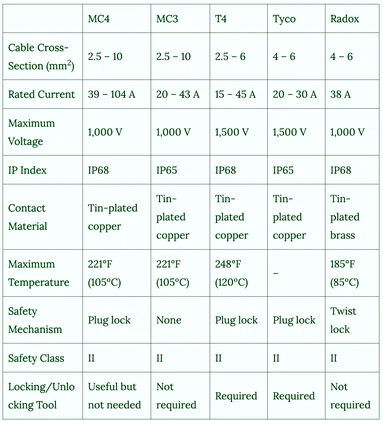
4.4. Other differences
Compatibility
MC4: compatible with a variety of solar modules, easy to install and maintain.
Y-branch connector: usually paired with MC4 connector to create a parallel circuit.
T4, TYCO SolarLok, Radox: do not highlight information related to extensive compatibility with other modules.
Applicable scenarios
MC4: As an industry standard, it is widely used.
Y-branch connector: Mainly used in residential or small systems, it provides flexible configuration and is preferred in scenarios where parallel wiring is used to reduce the impact of shading.
T4, TYCO SolarLok, Radox: The document does not focus on their specific application scenarios, and they are generally applicable to general solar connections.
5. Application of solar connectors
As a key component in solar power generation systems, solar connectors play an important role in ensuring that solar power can be safely and reliably transmitted and utilized.
Application areas
1) Solar photovoltaic power stations
Large solar power stations are usually composed of hundreds or even thousands of photovoltaic modules. Connectors are crucial to the stability of power transmission and system efficiency.
2) Distributed photovoltaic power generation systems
Distributed photovoltaic systems are often installed on residential roofs or commercial buildings. The convenience and reliability of connectors are crucial to the operation of the system12. 3) Charging piles and photovoltaic carports
The connectors of solar charging piles and photovoltaic carports are not only used to access the power grid, but also to connect photovoltaic modules and charging equipment
Application of solar connectors
Choose the plan that suits you best.

Solar photovoltaic power stations
Large solar power stations are usually composed of hundreds or thousands of photovoltaic modules. Connectors play a key role in the stability of power transmission and system efficiency, ensuring smooth flow of current and improving power generation efficiency.

Distributed photovoltaic power generation system
Distributed photovoltaic systems installed on the roofs of residential or commercial buildings rely on the convenience and reliability of connectors to ensure the normal operation of the system and facilitate maintenance and upgrades.

Charging station
In solar charging stations, connectors are used to connect photovoltaic modules to charging equipment and power grids to achieve efficient transmission of clean energy and support fast charging of electric vehicles.

Photovoltaic sheds
Photovoltaic sheds not only provide shade and protection for agriculture, but also generate electricity from solar energy. Connectors ensure reliable connections between photovoltaic modules and power systems in these applications.
6. How to connect solar connector wires
Solar panel wiring is a technical job. The following are the steps for wiring solar panels, taking the MC4 connector as an example:
6.1. Connecting and crimping MC4 connectors
1. Gather the required tools: You need a wire stripper, a crimping tool designed specifically for MC4 solar connectors, MC4 connectors (male and female), and appropriate solar wires.
2. Turn off the system: Before you start, make sure the solar system is turned off to avoid electrical hazards.
3. Strip the insulation of the wire: Using a wire stripper, carefully strip about 1 cm (0.4 inches) of insulation from the end of the solar wire to expose the metal conductor.
4. Assemble the connector: Slide the appropriate MC4 connector housing (male or female) onto one end of the stripped wire. Make sure to slide on the waterproof sealing cover and metal lock.
5. Prepare the crimping tool: Open the crimping tool and insert the MC4 crimp pin (male or female) into the designated slot.
6. Crimp the connector pin: Insert the stripped end of the solar cell wire into the crimp pin held by the crimping tool. Squeeze the handle of the crimping tool firmly to press the pin onto the wire, creating a strong and secure connection. Release the handle and remove the crimp pin from the tool. Gently pull on the wire to ensure a secure crimp.
7. Insert the crimp pin into the connector housing: Push the crimp pin into the MC4 connector housing until it clicks into place, ensuring a secure connection.
8. Assemble the connector: Slide the waterproof seal and metal locking tab toward the connector housing. Tighten the seal gland onto the connector housing to create a waterproof seal.
9. Test the connection: Once the crimped solar connector is securely connected to the wire, connect it to the corresponding connector on another solar wire (male to female, or vice versa). The connectors should click together, indicating that the connection is secure.
6.2. Locking and Unlocking
Locking and unlocking solar connectors is critical to ensuring a secure connection in a solar system. Most solar connectors, such as MC4 connectors, are designed with a built-in locking mechanism to prevent accidental disconnection and maintain a reliable electrical connection.
Locking a solar connector: When connecting a solar connector, simply align the male and female connectors and push them together. You will hear a click, indicating that the locking mechanism has engaged. The built-in locking mechanism prevents the connector from accidentally pulling apart, ensuring a stable connection throughout the operation of the system.
Unlocking a solar connector: To disconnect an MC4 solar connector, you need a special unlocking tool called an MC4 disconnect tool or MC4 wrench. Other types of connectors may have their own special unlocking tools. These tools can unlock the locking mechanism and safely separate the connector without damaging it.
Summary
1. Solar panel connectors ensure electrical efficiency and reduce power loss; prevent danger, adapt to harsh environments, and extend system life; facilitate system expansion and achieve flexible configuration; simplify installation and maintenance, and ensure component compatibility.
2. Different types of connectors differ in purpose, design (polarity, installation method), performance (current carrying, durability), compatibility and applicable scenarios.


